Selecting a personal lubricant
Is your personal lubricant working with, or against your body?
Two invisible properties help decide that outcome: osmolality and pH.
They rarely appear in marketing headlines, yet they matter more to long-term comfort, tissue health, and pleasure than almost any ingredient, texture, or packaging ever could.
Osmolality: how “thirsty” a formula is
Osmolality describes how concentrated a liquid is compared to the cells it touches. Vaginal tissue naturally sits around 285–295 mOsm/kg. This balance keeps cells hydrated, elastic, and resilient. When a lubricant is far from this range, the body compensates.
High osmolality (hyperosmotic)
Pulls moisture out of vaginal cells
Leads to dryness over time
Increases micro-irritation and friction
Raises risk of inflammation and infections
"Hyperosmolar Sexual Lubricant Causes Epithelial Damage in the Distal Colon" Source
Unfortunately, many mass-market lubricants fall into this category because high sugar and glycerin content boost shelf stability and initial slickness. Many test in the thousands, a far cry from your natural balance.
Low osmolality (hypo-osmotic)
Pushes water into cells
Can cause swelling and cellular stress
Still disrupts the natural barrier
The ideal: iso-osmotic
A lubricant that closely matches the body’s natural hydration level. Cells stay balanced. Tissue stays intact. Sensitivity stays where it should be.
"Dezzutti found that lubricants with osmolalities close to extracellular body fluid had the least effect on cell viability." Source
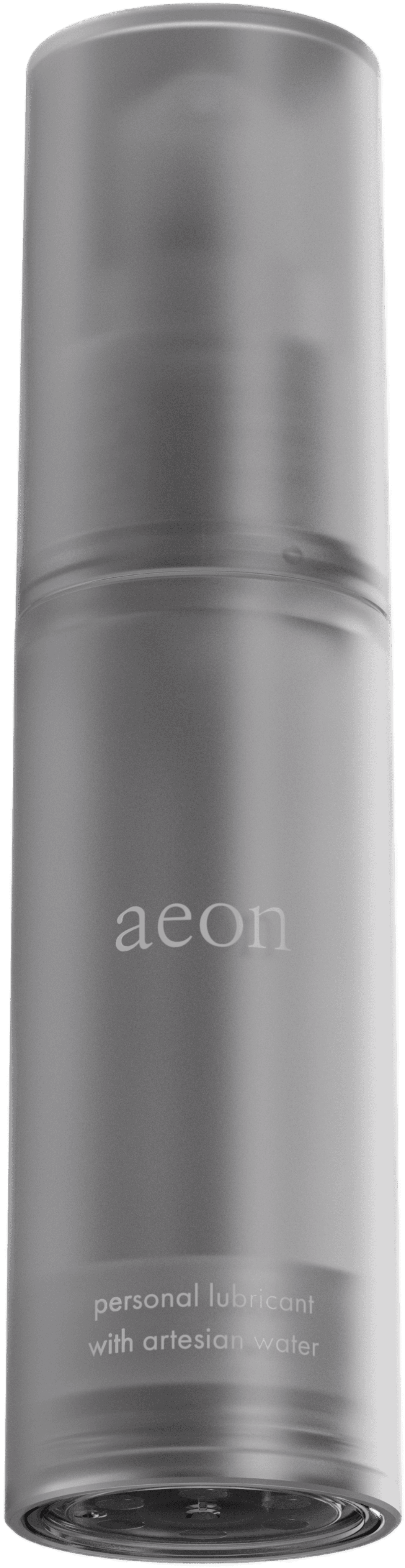
That is the standard Aeon is built around. Our personal lubricant is gentle on mucosal tissue thanks to an osmolality of ~360 mOsm/kg (approx. neat, tested on a diluted sample according to USP <785>).
pH: The gatekeeper of your microbiome
pH controls the environment your microbiome lives in. A healthy vaginal pH is naturally acidic, typically between 3.8 and 4.5.
This acidity protects beneficial bacteria like lactobacilli, which in turn:
Prevent infections
Maintain natural lubrication
Support tissue repair
Regulate odor
When a lubricant is too alkaline or unstable:
Beneficial bacteria decline
Harmful microbes gain ground
Irritation becomes more likely
Recurrent imbalances become easier to trigger
pH is not cosmetic. It is biological infrastructure. Our lubricant's pH tests between 4.0 - 4.5 (@25°C, 1:4 dilution, USP) so it's compatible with the vaginal environment.
What makes Aeon better
Aeon was developed as a personal-care product, not a novelty item.
Our formula is:
Near iso-osmotic to vaginal tissue
pH-balanced to support the natural microbiome
Designed to stay gentle across repeated use
The result is lubrication that works with your body instead of against it.
You don't have to think about any of these
Good lubrication should disappear into the experience.
Not announce itself with burning.
Not follow you with dryness.
Not rewrite your body’s chemistry.
When osmolality and pH are right, the lube becomes invisible. Only the moment remains.